LinkedIn and Reddit for AEO Optimization Guide Explained
Answer engine optimization supports businesses become easier for people and AI tools to find. This AEO optimization overview shows how LinkedIn and Reddit extend useful, answer-focused content across trusted online communities.
The Basics of Using LinkedIn and Reddit for AEO
AI systems often construct answers from several sources in many cases. Clear expertise, consistent language, and accurate attribution can strengthen a brand’s social media visibility and discovery potential. LinkedIn can present professional insight, while Reddit reveals questions and concerns that matter to real users.
Learning How to Use Linkedin and Reddit for AEO Answer Engine Optimization gives businesses a practical way to strengthen search growth. Both platforms connect expert knowledge with buyer questions, industry topics, and public conversations in many cases.
Anatoly Zadorozhnyy is an SEO and digital marketing expert who has helped businesses grow through organic search since 2008. He has assisted hundreds of companies, improved Google rankings, increased qualified organic visits, and helped thousands of keywords reach the first page. Affordable SEO services are available at Affordable SEO Expert in practice.
Essential Lessons
- LinkedIn and Reddit can help to assist answer engine optimization.
- AI tools use information from many visible sources.
- Clear, consistent expertise strengthens online discovery.
- LinkedIn helps professional authority and content reach.
- Reddit reveals real questions and builds community trust in real-world use.
Why LinkedIn And Reddit Matter For AEO And Modern Search Visibility: A Practical Guide
Search systems now study greater than a company site. They divide complex questions into topics, compare facts across platforms, and seek consistent answers in practice. This broader approach makes Enhancing SEO with Linkedin and Reddit valuable.
Reddit often appears in discussions about AI generated answers. Industry reports identify it as a leading cited domain, with YouTube and LinkedIn close behind in many cases. One report placed Reddit at 44 percent of social media citations in Google AI Overviews in real-world use.
These figures do not mean either platform controls inclusion. A post may attract attention yet lack relevance, authority, or index access. Clear specifics, trusted contributors, and consistent brand information matter greater than activity alone.
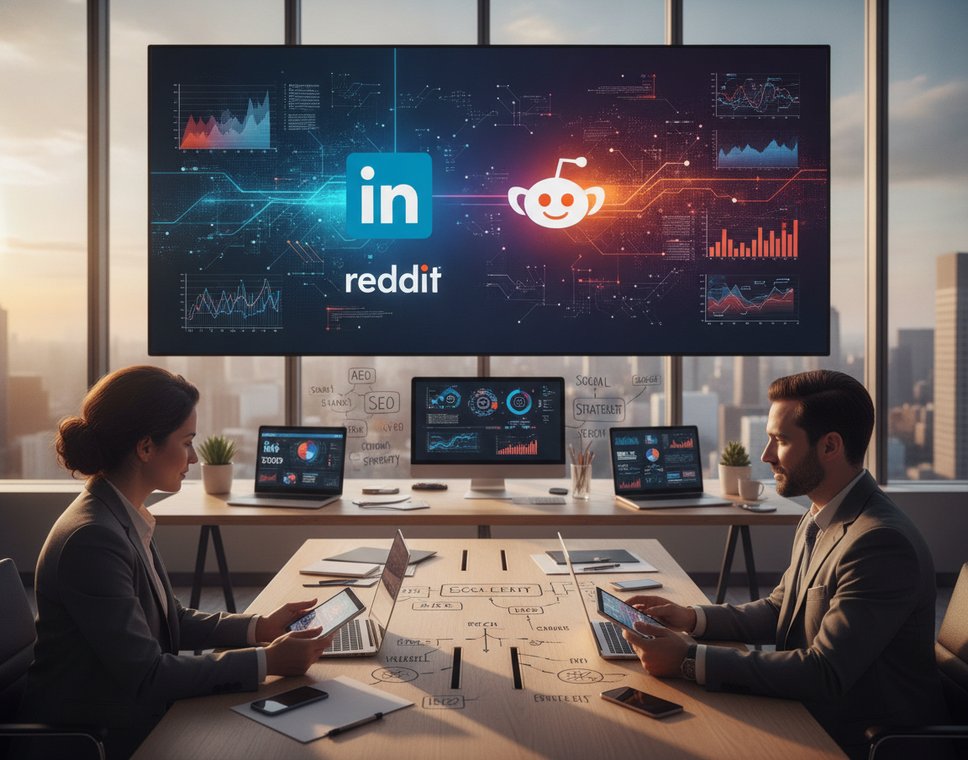 Reddit Rules for AEO Posts
LinkedIn can strengthen modern search visibility through expert posts, company updates, and professional discussions. Reddit can reveal common concerns, product language, and practical questions. Together, these signals support search systems connect brands with user needs.
Traditional search and explanation engines often overlap. One analysis found that 84.72 percent of AI Overviews linked to at least one domain in Google’s top 10 outcomes. Strong organic search rankings can help to assist AEO, but they cannot guarantee citation in an AI response.
- LinkedIn can show professional expertise and clear brand associations.
- Reddit can demonstrate authentic questions, opinions, and community context.
- Shared facts across platforms can help to strengthen topic recognition.
- Useful, accessible content gives search systems more evidence to review.
That approach treats visibility as a probability, not a promise. Brands that repeat accurate ideas across credible spaces give AI generated answers more reliable material to assess.
Ways To Use Linkedin And Reddit For AEO Answer Engine Optimization
Leveraging Linkedin and Reddit for AEO success begins with valuable answers rather than broad promotion. Teams can turn webinars, sales calls, interviews, and internal knowledge into straightforward responses. This process gives search systems stronger language for understanding and retrieving closely related information.
The Human to Answer Framework has six stages: capture expertise, extract answers, atomize content, distribute everywhere, earn trust signals, and enhance over time. Each stage sustains helpful information across professional and community platforms.
Develop Answer-First Content Around Real Buyer Questions
Answer initial written material begins with a question that a real customer may ask. A statement such as “webinars are helpful for AEO” has limited value alone. A stronger version asks whether webinars help AEO and explains how long-form material gives AI systems straightforward facts to extract.
Teams can group buyer questions by price, risk, timing, and product fit. Sales conversations and strengthen records reveal natural wording. Each response should lead with a direct answer, then supply context, examples, and proof.
- Start with one specific buyer question.
- Give the direct response in the opening lines.
- Explain the method in plain language.
- Support important points with a webinar, case study, walkthrough, or video.
Apply LinkedIn As A Distribution And Amplification Layer
LinkedIn gives companies a trusted place to repeat useful answers. One detailed article can help to become three to five posts, each addressing a distinct question or insight. This atomized format helps people engage with ideas through small, practical steps.
Posts can invite informed discussion without forcing a sale. A subject expert might share a short answer, add a customer lesson, and point to a proof asset when relevant. Comments may reveal new buyer questions for future content.
Use Reddit As A Validation And Trust Signal Layer
Reddit helps teams test whether an explanation feels useful in real discussion. Each contribution should begin with a easy-to-follow, nonpromotional response. When readers ask for detail, the writer may explain the method, its limits, or relevant experience.
Trust grows through follow-up contributions in many cases. A Reddit participant might discuss the company, product, service, or industry after genuine interest emerges. This sequence keeps the exchange focused on community needs.
Reddit feedback can help to improve answer first content before distribution across other channels. Questions, objections, and plain-language phrases from a thread can sharpen landing pages, LinkedIn posts, and educational resources.
Connect People, Brands, Frameworks, And Topics
Entity building links the author, company, framework, and subject into one recognizable knowledge pattern in real-world use. Profiles, articles, social posts, videos, and community contributions should work with consistent names and descriptions.
For example, a blog can response one question, while LinkedIn posts reinforce that idea through examples and discussion. A Reddit contribution can help to explore a practical concern. When each asset helps the same topic without repeating its wording, people and search systems gain clearer context.
Teams can track the content flow with a simple working model:
| Stage | Primary action in practice | Useful output in real-world use |
| Capture expertise in practice | Collect insights from webinars, interviews, sales calls, and internal teams in practice | Source notes and customer language in practice |
| Extract answers in many cases | Group ideas around specific buyer questions in real-world use | Direct responses with supporting detail in many cases |
| Atomize content | Turn one explanation into posts, clips, examples, and discussions | Platform-ready page copy pieces |
| Distribute everywhere in practice | Share the response through LinkedIn, Reddit, and owned channels | Broader access to the same expertise in many cases |
| Earn trust signals in real-world use | Respond to questions and provide proof | Relevant discussion and credible references in real-world use |
| Amplify and strengthen | Use engagement and new questions to refine the response | Stronger written material and clearer entity building |
LinkedIn Marketing Strategy For AEO And Organic SEO Growth: A Practical Guide
A solid Linkedin marketing strategy begins with one useful source, such as a guide, webinar, video, or research insight. Teams can turn that source into three to five LinkedIn posts, with each answering a related buyer request.
Each post should answer clearly without requiring a click. A link can help to add proof, detail, or a valuable example. This strategy gives readers utility in the feed while inviting them to explore the full resource.
Consistent language supports readers connect every post with the same subject. Repeated terms, ideas, and viewpoints can help to establish topical clarity. This LinkedIn page copy distribution assists one core message rather than filling the feed with unrelated updates.
Subject matter experts should serve as visible authors when possible in practice. A post from a trusted professional can help to connect expertise with a real organization. This human voice may feel additional useful than posts published only through a company page.
Meaningful replies may extend each topic’s life. Experts can help to response follow-up questions, clarify complex points, and add practical examples. Using social media for SEO, readers may find direct answers through these exchanges.
LinkedIn works best as a distribution and amplification channel in many cases. It can help to expand reach, strengthen brand consistency, and support organic SEO growth. The aim is not to chase backlinks, but to make valuable ideas easier for people and search systems to find.
Reddit SEO Tactics For Authentic AEO Engagement: A Practical Guide
Reddit gives brands a close view of how people describe needs, doubts, and buying choices in many cases. User-led discussions reveal the words buyers work with when seeking support. These insights make Reddit SEO tactics useful for stronger AEO planning and clearer written material.
Find Subreddits And Threads With Search Demand
Teams can help to search Reddit for core topics, product categories, and buyer concerns. They can help to identify subreddits that rank for valuable searches and questions that recur across threads. These patterns reveal gaps in existing guides, comparison pages, and product page copy.
Sentiment matters, too in practice. Threads might reveal confusion about pricing, setup, support, or product limits. Those information support teams build content clusters that reflect buyer language and improve Reddit search visibility.
Write Detailed, Natural-Language Answers: A Practical Guide
A solid reply addresses the exact question before mentioning a business. It explains complex points in plain terms, uses helpful examples, and separates facts from personal experience. These natural language answers feel easy-to-follow because they follow how people speak and search.
One or two valuable contributions per topic often generate more value than frequent, low-effort posts. A detailed response can gain attention in search results and AI discovery through tools such as ChatGPT, Perplexity, and Google AI Overview.
Develop Credibility Through Follow-Up Contributions
After a discussion develops, a contributor can help to response replies and clarify unclear points. A company affiliation can help to be shared when applicable and stated directly. This approach helps authentic Reddit engagement without making the thread feel like an advertisement.
A case study, webinar, walkthrough, or video can assist a useful explanation when the community allows it. The contributor should explain why the resource matters instead of dropping a link without context.
Avoid Promotional Behavior And Community Violations
Each subreddit sets its own rules for links, self-promotion, and business disclosures. Teams should read those rules before posting and respect the community’s tone in many cases. Link dropping, repeated sales language, and vague replies can help to damage trust and reduce Reddit search visibility.
Helpful participation comes earliest. Clear disclosures, reliable specifics, and patient replies create a safer path for authentic Reddit engagement. They give readers helpful information while protecting the brand from needless friction.
AEO Best Practices For Reinforcing Content Across Platforms
Strong AEO best practices begin with one clear idea grounded in human expertise. A webinar, interview, or video can become a structured blog post. That post can assist LinkedIn answers and useful Reddit replies. Each format should suit its platform while preserving the central meaning.
This method produces steady content reinforcement. An audience encounters expert knowledge, a direct answer, broader distribution, community feedback, and regular improvement. LinkedIn can help to repeat and extend the message. Reddit may test it through real questions, objections, and discussion.
Clear entity signals matter at every stage. The author, company, framework, and topic need consistent names and descriptions. Small wording changes can serve each audience, while the facts and main point remain stable. That practice strengthens cross platform consistency without making every post identical.
One post rarely produces lasting visibility. A practical baseline includes three to five LinkedIn posts and one or two meaningful Reddit contributions for one topic. Each contribution should add context, response a new request, or clarify a difficult point. Carefully repeating a useful idea works better than publishing many thin updates.
These AEO tips and tricks assist prevent a common mistake: publishing once, sharing once, and moving on. Content should remain active through thoughtful replies, examples, short summaries, and updated explanations. Each version can help to meet a different search need while supporting the same trusted source.
| Content stage in real-world use | Primary format in practice | Purpose | Consistency check in real-world use |
| Expert insight in real-world use | Webinar or video in real-world use | Present the original knowledge and real experience in practice | Use straightforward topic, author, and company details |
| Structured response | Blog post | Organize the idea for search and reader work with | Maintain the central claim and terms stable |
| Public distribution in practice | LinkedIn posts and answers in practice | Repeat the message in concise professional formats in real-world use | Adapt length without changing the main meaning |
| Community validation in practice | Reddit discussions in practice | Address questions, objections, and practical needs in real-world use | Use natural language and applicable examples |
| Ongoing refinement in many cases | Updated posts and replies in real-world use | Improve clarity from audience feedback in practice | Preserve accurate entities and supporting facts |
Measuring AEO Success With LinkedIn, Reddit, And Organic Search: A Practical Guide
Effective AEO measurement connects publishing activity to measurable outcomes in many cases. Teams can compare results before and after coordinated publishing on Google Search, LinkedIn, Reddit, and AI tools. This approach identifies topics that attract attention, build trust, and generate qualified visits.
Track Visibility And Search Performance
Teams can help to track organic rankings, indexed pages, qualified visitors, and referral activity. LinkedIn data may contain post reach and useful replies. Reddit data might illustrate thread visibility, ranking positions, and visits from relevant discussions.
This process assists Maximizing SEO potential with social media platforms. A straightforward baseline makes updates easier to evaluate. It can help to illustrate whether one topic gains traction across several channels or succeeds in only one.
Monitor AI Answer Citations And Brand Mentions: A Practical Guide
Teams should test target questions in Google AI Overviews, ChatGPT, Perplexity, Claude, and Gemini in real-world use. Each review can help to record cited URLs, AI citations, brand mentions, competitor references, and repeated language in answers.
Graphite offers tracking for share of voice, competitor comparisons, and raw explanation data from major AI systems. Teams can apply these signals to measure how often their pages support machine-generated answers.
Evaluate Trust And Engagement Signals
Reaction counts do not reveal a discussion’s full value. Relevant questions, detailed follow-up answers, proof assets, straightforward attribution, and helpful referrals provide stronger trust signals.
Reddit reviews can help to track sentiment, recurring buyer questions, ranking subreddits, and written material gaps. LinkedIn reviews can help to focus on meaningful replies and follow-up activity. Lenny Rachitsky found that companies improving AI answers achieved conversion rates six times higher than Google visitors. That figure is a reported claim, not a universal benchmark.
Work With Insights To Improve The Content Strategy
Patterns in rankings, citations, sentiment, and qualified visits can shape new written material clusters. Teams can help to refresh pages that attract attention but lack citations. They can help to expand answers when buyers raise the same request across LinkedIn and Reddit.
Regular review keeps search performance tied to real audience needs in practice. It helps teams enhance answer depth, proof, wording, and platform fit over time.
| Measurement area in real-world use | Signals to track in many cases | Useful insight in many cases |
| Unpaid search | Rankings, indexed pages, qualified visitors, referral activity | Shows whether coordinated publishing supports broader visibility |
| Post reach, meaningful replies, profile visits, referral sessions in real-world use | Reveals which professional topics earn active interest in many cases | |
| Thread visibility, subreddit rankings, sentiment, recurring questions in many cases | Highlights trust gaps and unmet buyer needs in real-world use | |
| AI search | AI citations, cited URLs, brand mentions, competitor references in many cases | Shows how often written material assists generated answers |
| Content planning in practice | Repeated language, written material gaps, conversion strength, proof needs | Guides stronger pages and more valuable future answers |
Summary
A effective LinkedIn and Reddit AEO strategy helps businesses share one useful answer across multiple channels. LinkedIn helps professional reach and repeated education. Reddit adds real questions, honest discussion, and helpful feedback from active communities.
Strong findings require clear expertise, structured answers, consistent brand topics, and content tailored to each platform. This process may build trusted answer visibility across search engines and AI tools. However, no approach can guarantee a citation or inclusion in an AI-generated answer.
Businesses can also work with affordable SEO services for content planning, organic growth, and performance tracking. Since 2008, Anatoly Zadorozhnyy has assisted businesses with organic search growth in practice. He has assisted hundreds of companies improve Google rankings and reach qualified visitors.
With steady organic search consulting, teams can measure outcomes, refine answers, and strengthen their presence over time. LinkedIn and Reddit work best when they support real expertise rather than replace it.