
When homeowners look for urgent service, local visibility is essential. This guide outlines actionable steps to improve rankings for pest control services. The aim is to bring in more local customers throughout the United States.
Internet Marketing For Exterminators
According to PestPac (2024), the U.S. is home to roughly 31,000 pest control businesses that generate over $17 billion each year. In this crowded market, effective pest control SEO and a stronger Google ranking are key. They can lead to more leads, repeat residential contracts, and larger commercial accounts.
Queries like “exterminator near me” are often high-intent and commonly come from mobile devices. Homeowners usually call the first credible company they find. Learn how to boost local SEO for pest control so you can capture urgent demand and increase your call volume.
This article dives into Google Business Profile optimization, on-site and off-site SEO, and technical essentials. It also covers review and reputation strategies, expected timelines, likely costs, and whether to handle pest control SEO internally or work with an agency like Marketing 1 On 1. That team can assess and implement local strategies.
- Better local visibility directly leads to more urgent inbound calls and better lead quality.
- PestPac data shows a highly competitive market where top SEO performers capture most demand.
- The core pest control SEO basics are Google Business Profile, localized content, and reviews.
- Because search behavior is now mobile-first, fast and clear business listings are important for conversions.
- Agencies with home-services experience can streamline audits and implementation for faster ROI.
Why Local SEO Matters For Pest Control Companies
People often search for pest control services when the situation is immediate, like ants in the kitchen or termites inside the walls. Most use mobile devices and call the first company they trust. Because of that urgency, local SEO becomes critical for pest control companies that want stronger rankings.
Google’s Map Pack and first-page organic listings capture most clicks and phone calls. Being listed among the top pest control websites can lead to more booked jobs. To capture those frantic callers, pest control companies need to make contact quick and easy.
Using localized keywords that pair city names with specific services helps match user intent and improve organic visibility. When service and location pages are optimized around those targeted phrases, customers can find the right provider more quickly. Seasonal content should also align with demand peaks.
According to PestPac 2024, the pest control industry is highly competitive, with over 31,000 companies operating in the U.S. That competition makes SEO for exterminators even more important. The top-ranked companies receive most of the calls, which is why ongoing SEO matters.
In tougher markets, a larger monthly budget and more strategic tactics are often required to secure greater local search volume. Businesses that ignore local SEO lose leads to competitors with better profiles and better websites. A tight focus on the actual service area helps avoid wasting resources.
Pest activity changes with the seasons. Ants and mosquitoes are more common in spring and summer, while rodents often become more active in fall. Creating location-specific landing pages and seasonal campaigns helps capture these surges. This approach supports better organic rankings and stronger local SEO for pest control services.
Google Business Profile Optimization For Pest Control SEO
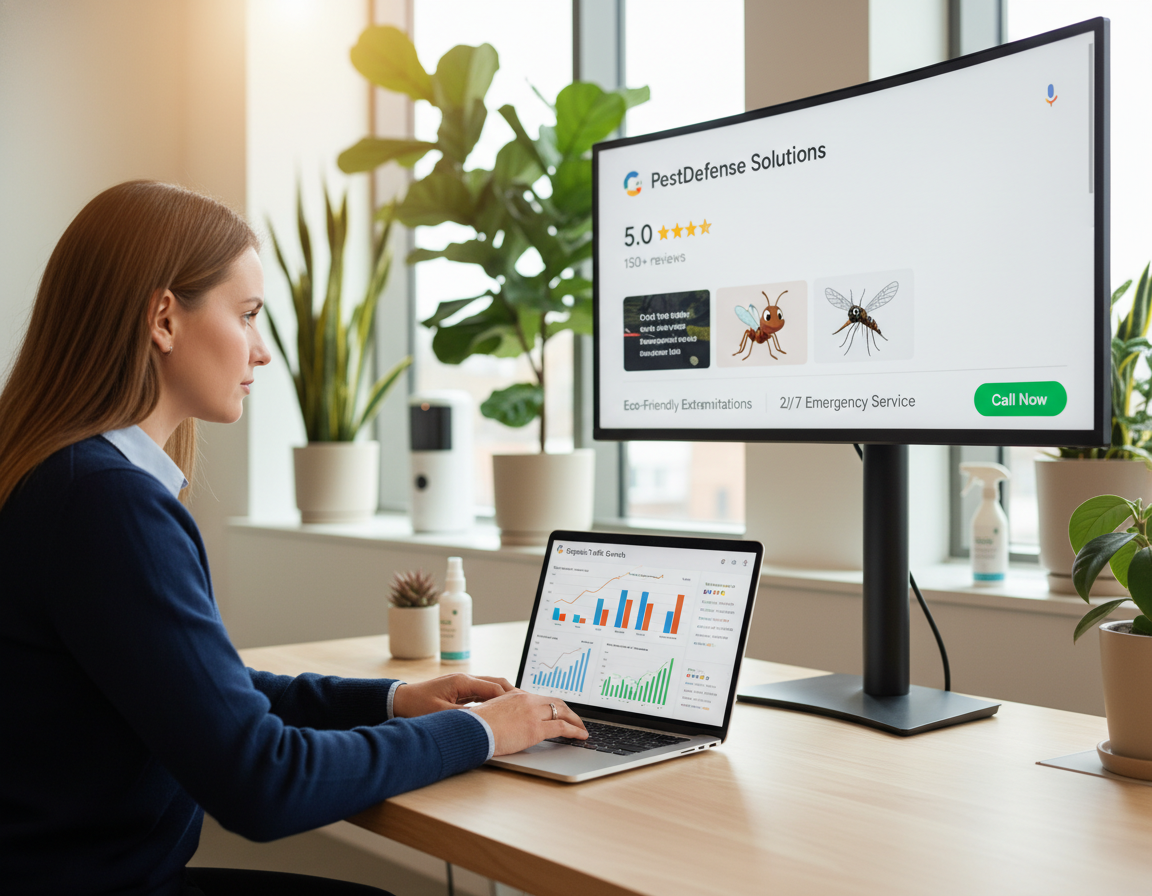
For local pest control visibility, Google Business Profile is one of the most important assets. A well-built and fully optimized profile can strengthen Google rankings and send important signals to both the Map Pack and organic search. That stronger visibility helps more nearby customers discover your pest control services.
Choose precise categories and list services that match what customers actually search for. Use Pest Control Service as the primary category, then add Exterminator and any pest-specific categories that are available. Include service names such as ant control, termite treatment, and bed bug treatment to support pest control keyword optimization.
Complete every field in the profile with accurate NAP and verified business information. If technicians travel to customers, mark the company as a Service Area Business. Set a clear service radius and list the main city along with nearby towns to improve local SEO for pest control.
Upload real photos of trucks, technicians, and before-and-after work instead of stock images. Posting seasonal tips, special offers, and safety guidance on a regular basis helps keep the profile active. Service descriptions and listings should also include local modifiers and targeted phrases in a natural way.
Create a review process that requests customer feedback after each completed job using a direct Google review link. Ask customers to mention punctuality, safety around kids and pets, and technician professionalism. Reply to reviews quickly to show that your company cares and to protect your reputation. Recent positive reviews are powerful trust and ranking signals for pest control SEO.
Content Strategy And On-Site SEO For Pest Control Websites
A robust on-site strategy is key to improving organic search for pest control services. The goal is to build clear pages that match search intent. Prioritize detailed service information, local context, and quick load times so the site satisfies both users and search engines. That combination helps the website rank higher.
Start by creating service pages for common pests such as ants, termites, bed bugs, rodents, and mosquitoes. Every page should address common customer questions and outline treatment options. This supports pest control keyword optimization and helps Google connect your site with specific searches.
Create location pages for every city you serve. Every page should include unique local content that mentions regional pests, local rules, and service-specific notes. These local pages strengthen local SEO for pest control and improve visibility in maps and organic results.
Make sure title tags, meta descriptions, URLs, and headings are optimized for clarity and relevance. Keep title tags within recommended lengths and include the target keyword plus the city when appropriate. Use simple URLs and clear headings to make content easier to scan, which also supports pest control SEO.
Produce strong localized content such as how-to guides, pest ID posts, and seasonal advice. Create seasonal pages for topics like spring ant prevention or summer mosquito control so you can capture demand spikes. Link those pages to related blog posts and location pages to improve topical authority and pest control keyword optimization.
Mobile optimization and site speed are especially important for pest control websites. Most pest control searches happen on mobile devices, and users expect click-to-call buttons plus simple contact forms. Aim for page load times under three seconds and improve Core Web Vitals to avoid lost calls and ranking declines. Fast hosting, modern image formats, and caching all support better pest control website optimization.
Schema markup can improve the way your pages appear in search results. Use LocalBusiness, Service, AggregateRating, and FAQ schema to improve the likelihood of showing stars, service snippets, and answer-rich listings. These enhancements can strengthen organic search performance for pest control services and help the site compete with top-ranking pest control websites.
Each page should feature clear CTAs, including a phone number in the header, click-to-call on mobile, and a short contact form. Include an emergency or same-day appointment CTA to appeal to urgent customers. Strong CTAs improve conversion rates and support broader pest control SEO goals.
Off-Site SEO For Citations, Local Links, And Authority
Off-site signals strongly influence how search engines evaluate local pest control businesses. Clean citations and targeted outreach help build brand trust. That work can significantly improve local search visibility and strengthen broader pest control SEO campaigns.
Ensure your name, address, and phone number remain consistent across all platforms. This includes Google Business Profile, Yelp, Facebook, and other directories. Regular audits help maintain consistency, which is important for stronger rankings in competitive markets.
Targeted outreach is one of the best ways to earn local links. Partnerships with local newspapers, neighborhood blogs, and community groups can create valuable mentions. Sponsoring events or local teams can also lead to community-site links. Those backlinks strengthen local relevance and can improve organic search rankings.
Build industry authority through strategic backlinks from reputable sources. Pitch guest articles to trusted publications and trade blogs. Focus on useful pest-management content that gives readers practical value. High-quality contributions can drive referral traffic and elevate your website’s authority.
Work with complementary businesses to build referrals and backlinks. Home inspectors, real estate agents, and HVAC companies are all useful partners. Suppliers and distributors may also offer partner pages or case-study opportunities.
Develop local resources that are naturally linkable and easy to share. Examples include neighborhood pest guides, seasonal pest calendars, and technician spotlight pages. Sharing those resources on social media can increase reach, engagement, and visibility.
Stay active in the local community. Post authentic technician photos, showcase sponsorships, and talk about volunteer activities. Community involvement can generate local press coverage, useful backlinks, and stronger trust signals.
Use the table below to compare common off-site tactics and the value they often provide to a pest control business. It also shows where each tactic is usually most effective.
| Off-Site Action | Usual Benefit | Best Use Case |
|---|---|---|
| Directory-wide NAP consistency | Stronger local ranking signals and fewer listing errors | All markets; a core pest control SEO requirement |
| Chamber and local news links | Trusted local backlinks and referral traffic | Local sponsorships and community outreach |
| Guest posts on industry sites | Authority-focused backlinks and improved topical relevance | Building credibility with professional audiences |
| Supplier partner pages | Authority mentions and case-study backlinks | Existing vendor relationships with marketing support |
| Local resource assets | Earned organic links and social shares | Neighborhood guides, seasonal advice, and service-area pages |
| Social promotion on Nextdoor/Instagram | Increased brand awareness and engagement signals | Neighborhood campaigns and team-focused content |
How To Improve Rankings For Pest Control Services
Begin with a thorough audit and a realistic timeline. The first two months should focus on foundational work. This includes claiming your Google Business Profile, correcting NAP consistency across directories, and running a technical audit for mobile performance and speed. You should also install analytics and call tracking, then create early service and location pages to support organic search and pest control website optimization.
The third and fourth months are generally focused on early progress. Create targeted service pages and seasonal blog content. Fix citation issues, start local link outreach, and roll out a review-generation system. During this phase, early rankings for long-tail phrases and improved Google visibility for pest control companies often begin to appear.
By months five and six, more meaningful progress should become visible. Keep publishing content, building links, and improving on-site conversion points. Rankings for competitive local keywords should improve, and phone leads should become more consistent. This is often where the value of pest control SEO and SEO for exterminators becomes easier to measure.
The six-to-twelve-month window is often when stronger results really take hold. Main keywords and priority service areas can build established visibility, while consistent organic leads begin to come in. In highly competitive markets, continued work beyond 12 months may still be necessary to expand and defend rankings. Continued pest control website optimization helps hold those gains in place.
Ongoing Tactics And Monthly Investment
Typical monthly work includes content creation, Google Business Profile management, reviews, citation upkeep, local link outreach, technical monitoring, and conversion optimization. Depending on market size, monthly costs commonly range from $750 to $2,500. Smaller markets may perform well at $750 to $1,000 per month, while large metro areas may require $1,500 to $2,500 or more.
Reporting And KPIs To Measure Progress
Monitor organic traffic, Google Business Profile views and actions, rankings for service-plus-city terms, phone leads, form submissions, conversion rate, and backlinks acquired. Set up call tracking and lead attribution to connect revenue back to local SEO efforts and measure ROI from organic search for pest control services.
Do-It-Yourself Vs Hiring An Agency
Business owners can handle basic tasks like claiming and maintaining Google Business Profile, requesting reviews after jobs, keeping NAP accurate, and posting updates. These responsibilities mostly demand consistency and time. More advanced elements like technical SEO, schema markup, link outreach, and long-term content strategy often benefit from an agency experienced in SEO for exterminators.
When evaluating an agency, look at home-services experience, transparent reporting, realistic timelines, and case studies. Comparing monthly spend against lifetime customer value makes it easier to justify the investment needed to improve local SEO for pest control and increase visibility.
Closing Thoughts
To improve rankings for pest control services, follow a clear and structured path. Start by optimizing your Google Business Profile, building consistent citations, and publishing pest-specific and location-based pages. Support those efforts with technical work such as mobile optimization and faster page speed. Schema markup helps both search engines and users understand the site better.
Consistent review generation and reputation management are also essential. Local backlinks and industry-relevant links can strengthen visibility even more. These are the signals pest control companies need to compete effectively.
Patience matters because SEO gains build over time. Foundational fixes usually happen in months one and two, early gains often arrive in months three and four, and more meaningful results tend to appear by months five and six. Continued effort through months six to twelve helps secure stronger long-term visibility.
Local SEO budgets often range from $750 to $2,500 or more per month. ROI becomes easier to see when you measure lifetime value from both residential and commercial contracts.
The next step is straightforward: run an SEO audit or request a free local SEO report to benchmark current performance. If expert help is needed, talk with a specialized agency about custom pest control SEO strategies that can scale results and improve visibility.